Introduction
The District of Squamish is introducing a new Steep Slope Development Permit Area (DPA) as a key statutory tool to help mitigate natural hazard risks and support safe, responsible development. The DPA will apply to all lands with a slope greater than 30%.
Development Permit Areas are an established mechanism under provincial legislation that allow municipalities to manage development in areas with environmental constraints or hazards. Through this authority, the District can require technical studies, set development conditions, and ensure that risks related to steep slopes, such as instability, erosion, and drainage impacts, are properly addressed before development proceeds. Detailed requirements, decision-making roles, and applicable legislation at each stage of development are outlined in the Steep Slopes Hazard Management Table.
This is a new DPA designation proposed for inclusion in the Official Community Plan. It builds on existing steep slope policies by going further, providing clear development guidelines, application requirements, and expectations for hazard assessment and mitigation. A Steep Slope Development Permit will be required for subdivision, construction, excavation, placement of soil, and tree removal within designated steep slope areas.
The draft DPA support the District's broader strategy to reduce risk, protect the natural environment, and manage the visuals impacts of development. It also aligns with the Strategic Outcome of being Prepared for the Future, with a focus on strengthening resilience to natural hazards and climate-related challenges by September 2026.
Approach
The District of Squamish is taking a balanced and research-informed approach to developing the new Steep Slope Development Permit Area. The draft guidelines focus on two main themes: reducing risk and minimizing visual impacts.
This work has been shaped by best practices from other municipalities in British Columbia, along with input from geotechnical and environmental professionals familiar Squamish’s unique terrain and natural hazards.
The goal is to support safe, well-designed developments on steep slopes while protecting the natural character of the community.
Reducing Risk on Steep Slopes
Developing steep terrain can present challenges related to slope stability, and safety. The draft guidelines address these risks in several ways:
- A steep slope hazard assessment is required to confirm that land is safe for its intended use and to evaluate how ground and surface water may affect slope stability.
- Site grading, excavation, rock cuts, and retaining walls should be designed by qualified professional engineers.
- Road grades in strata developments should align with District of Squamish standards.
- Vegetation removed during development should be replanted to support slope stability and long-term resilience.
Together, these measures help ensure development is safe, durable, and aligned with professional standards.
Respecting the Natural Landscape
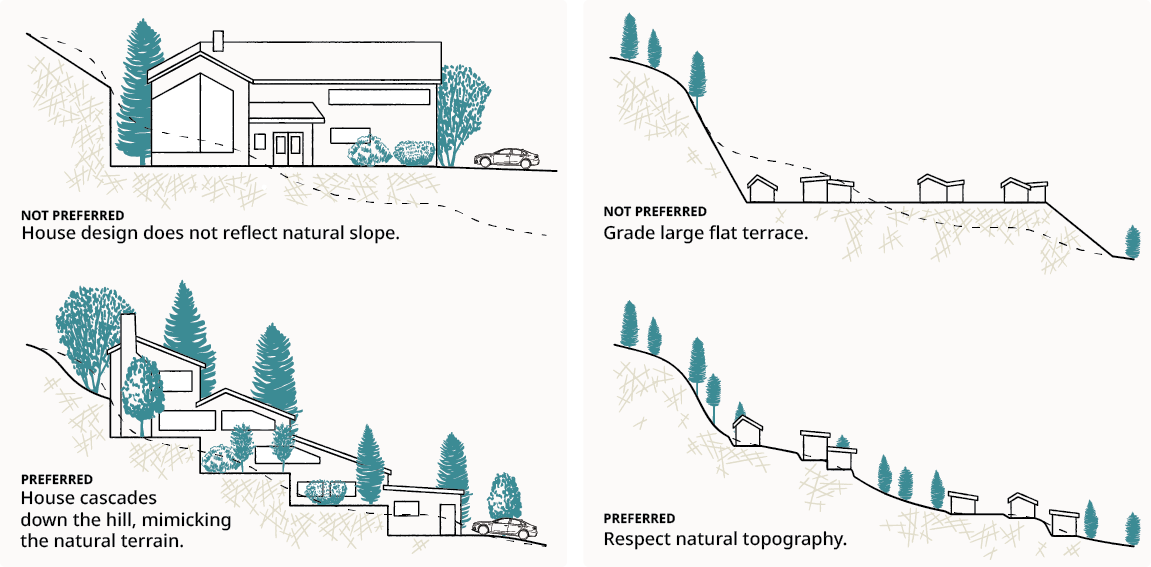
The draft DPA also considers how development appears on the landscape. Squamish’s steep hillsides and ridgelines are defining features of the community. The guidelines aim to ensure new development works with the land rather than dramatically reshaping it.
Key principles include:
- Buildings should follow the natural contours of the site. Stepped, clustered, and articulated forms are encouraged.
- Large-scale grading and the creation of expansive flat terraces on hillsides should be avoided.
- Altered slopes should use varied contours and vegetation to avoid sharp angles or a manufactured appearance.
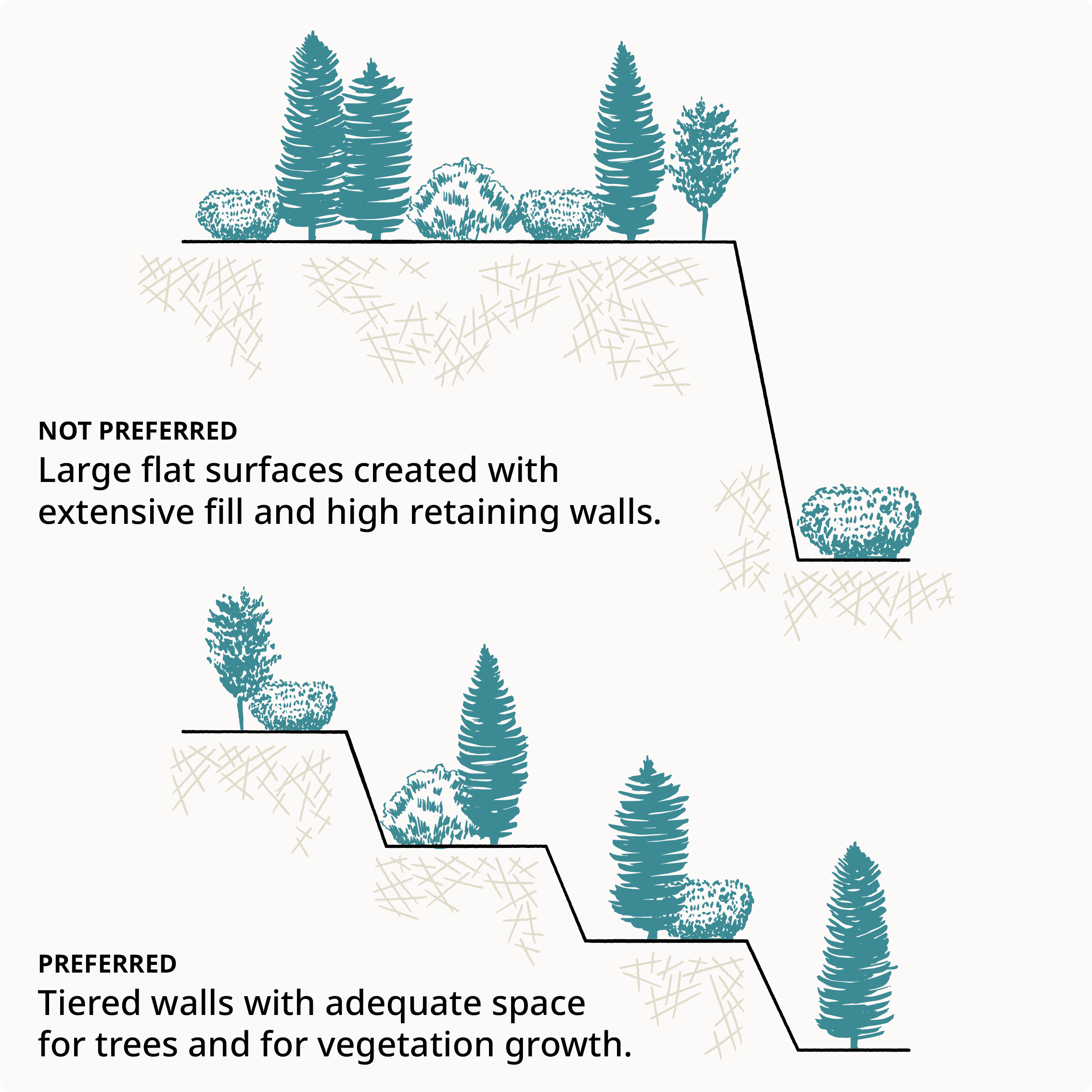
- Retaining walls should be minimized. Walls over 1.2 metres in height should be terraced where possible to reduce visual impact and allow landscaping.
- Retaining wall systems with vertical surfaces over 2.0 metres should be screened with buildings or fire-resistant native vegetation to soften their appearance.
- Trees and vegetation along ridgelines should be retained wherever possible. Buildings and roads should be located below ridgelines to maintain a natural skyline.
Together, these guidelines help maintain the visual character of hillside areas while allowing thoughtful development.
Balanced Development Guidelines
Developing steep slopes often involves balancing competing priorities. The draft guidelines reflect trade-offs between road safety, emergency access, environmental protection, and visual impacts.
Road Gradients and Emergency Access
The proposed DPA includes guidelines that roads in strata development should meet the regulatory requirements of the Subdivision and Development Control Bylaw. The intention is to support District of Squamish emergency response vehicles in Squamish, which may be required to access homes using strata roads. Steeper road gradients can create safety concerns, particularly during snowy conditions. Lower gradient roads can improve safety and accessibility.
Road Gradients and Site Alterations
Achieving lower gradient roads often requires wider and deeper cuts through terrain, which can have additional impacts. This can result in:
- Increased visual impacts
- More extensive retaining walls
- Greater environmental disturbance
- Impacts on development opportunities
The DPA also includes guidelines for retaining walls. These guidelines are intended to limit visual impacts, improve aesthetics, and ensure alignment with the District’s Subdivision and Development Control Bylaw.
Importantly, DPA guidelines are not rigid standards in every circumstance. They are assessed in context. In some cases, higher gradient strata roads may be considered if achieving lower gradients would require extensive site alternation with significant environmental or visual impacts.
This context-based approach allows decisions to be informed by professional judgement while maintaining overall safety and design objectives.
How to Engage
Open House
We hosted an in-person open house to hear directly from community members and industry professionals. At the open house, participants were able to learn more about the draft guidelines, asked questions, and provided feedback to help ensure the guidelines were practical, effective, and supported both safety and responsible growth in Squamish.
The open house took place on Thursday, April 9, 2026 at St. John the Divine Anglican Church, Garibaldi Estates.
This engagement opportunity allowed participants to ask questions, share feedback, and discuss the draft guidelines in more detail.
Public Hearing
A Public Hearing will be held in the Council Chambers at the District of Squamish Municipal Hall to consider Official Community Plan Bylaw 2500, 2017 Amendment Bylaw (Steep Slopes Development Permit Area) No. 3244, 2026.
Public Hearings offer opportunities for people an opportunity to be heard and to present written submissions for the Hearing. People can participate by submitting written submissions, calling in by telephone, joining the meeting through electronic participation, or attending the meeting in person.
The Public Hearing is anticipated to be held October 6, 2026 at Municipal Hall; additional details will be made available on LetsTalkSquamish once the time has been finalized.
Frequently Asked Questions
The District of Squamish is developing a Steep Slopes Development Permit Area (DPA) to guide how future development occurs on steep terrain. This new draft DPA is being shaped by the Official Community Plan Hazard Land Policies that supports the creation of a Steep Slope DPA as part of the District’s broader strategy to reduce risk, strengthen infrastructure, and prepare for climate-related challenges. This work aligns with the Strategic Outcome of being Prepared for the Future, aiming to enhance hazard mitigation and community resilience by September 2026.
A Steep Slope Development Permit Area is a planning tool used to regulated development in areas where slopes could lead to hazardous conditions. The DPA includes guidelines that specify the specific treatments which must be applied for development within the specified area in order to manage the hazardous conditions.
Yes, it is possible for a property to be in multiple DPAs. For example, many properties within the Steep Slope DPA will also be included in the Wildfire DPA. The District of Squamish WebMap offers mapping of all DPAs under the Land Development>OCP & Land Use
If you need a Development Permit, you will have to complete and application form and submit an application fee. For most applications it will ne necessary to hire a qualified professional to produce a Steep Slope Hazard Assessment report. The report will identify whether the land is safe for the intended use, and if not, outline mitigation measures that would be required to make the land safe for the intended use.
- The Steep Slope Development Permit Area includes land in the District of Squamish that has a gradient of 30% or more.
- Lands included in the DPA can be viewed here.
Check the District of Squamish map at:
If a property is included in the Development Permit Area, a Development Permit is required for the following activities:
- subdivision of land
- starting construction of, addition to, or alteration of a building or structure
- excavation or site grading, involving excavation or placement of more than 0.5 m depth of soil
- removal of trees
The following activities are generally exempt from the Development Permit requirement:
- lot line adjustments
- non-structural alteration, addition or repair of an existing building
- emergency circumstances to remove an immediate hazard
- the removal of hazardous trees
- accessory structures less than 10 m2
- fencing or hard landscaping.